August Can Jam: Homemade Ketchup

It’s not August until the tomato crop comes in, so it’s no surprise that this month’s Tigress Can Jam ingredient is the tomato. Fittingly, Golden Earthworm delivered 5 pounds of globe tomatoes with our regular vegetable share this week. Since I’m already getting a large share of plum tomatoes in a couple of weeks that will be devoted to “regular” canned crushed tomatoes, I wanted to have fun with these and try something I’ve been wanting to make for a while.  I have to admit, I was always a little reluctant to make homemade ketchup since it seemed quite labor intensive. But then I thought about how AWESOME it would be to top my NY State BOG burgers with NY State ketchup, and all hesitancy went out the window. In the recipe below, the tomatoes, onions and garlic are all from Golden Earthworm. In the end, it wasn’t that labor intensive. Sure there’s a food mill involved, and you steep spices in the vinegar before you use it, but these steps are worth it!

Homemade Tomato Ketchup

Yield: Two 1/2 Pint Jars. Adapted from Ball Complete Book of Home Preserving
  • 1.5 teaspoons celery seeds
  • 4 whole cloves
  • 1 whole allspice
  • 2/3 cup apple cider vinegar
  • 4 pounds tomatoes, cored and chopped roughly
  • 1/2 cup chopped onions
  • 3 cloves garlic, halved
  • Pinch cayenne pepper
  • 1/4 cup sugar
  • 2 teaspoons salt

  1. Tie celery seeds, cloves and allspice in cheesecloth, creating a spice bag
  2. Combine vinegar and spice bag, bring to a boil over high heat. When boiling, turn off heat, and let stand for 25 minutes. Discard spice bag.
  3. Meanwhile in a large saucepan, combine tomatoes, onion, garlic and cayenne. Bring to a boil over high heat, stirring frequently. Reduce heat and boil gently for 20 minutes. Add vinegar and cook for 30 minutes.
  4. Transfer mixture, little by little, to a food mill, cranking to extract all liquid. Continue until all the tomatoes have been through the food mill. Discard solids.
  5. Return liquid to saucepan, and add sugar and salt. Bring to a boil, then reduce heat and and boil gently until volume is reduced by half, and the ketchup thickens up. This will take around 45 minutes.
  6. Prepare canner, jars, lids. Read THIS if you don’t know what I’m talking about.
  7. Ladle hot ketchup into 1/2 pint jars, leaving 1/2 inch of headspace. Remove air bubbles, adjusting headspace if necessary. Wipe rim, center lid, and twist on screw band.
  8. Process in boiling water canner for 15 minutes. Remove and cool.

It really tasted like ketchup! I expected it to be more runny, or more tomato-y, but it was very savory, a little sweet, and actually tasted exactly like Heinz (in a good way). However, which would you prefer?! I’m so excited to be able to stock my pantry with this version!

Posted in Canning, CSA, Pantry, Recipes | Tagged , , , , , | 3 Comments

In a New York State of Black Bean Burger

As many of you know, we are members of a CSA, through which we get our glorious, local, organic produce from Golden Earthworm Organic Farm. What you might not know is that we are also members of 2 other CSAs. We get our weekly fruit deliveries from a North fork Fruit farm, Briermere Farms, as well as monthly grain, bean, and flour shipments from Cayuga Pure Organics (CPO). We found that last year during the vegetable and fruit seasons we still bought a lot of those items so we committed to 3 shares of bean, and 2 each of flour and grain.

In June, before our shipments from CPO even started, we took a week-long road trip through the Finger Lakes of Central New York State. When we stopped–unannounced–at CPO’s doorstep, we were welcomed in and lucky enough to get a guided tour of the whole operation from Erick Smith, one of the original founders of CPO. The awesomeness of their Rube Goldberg-esque bean sorting machines deserves its own post, but needless to say, we were so grateful to meet Erick, and thank him personally for the bounty we were expecting to receive. What we did not expect is how exciting it has been to try interesting grains that we never would think to buy, like the oat groats used in this recipe. I concocted this dish to showcase June’s bean (black bean) and July’s grain (oat groats) and flour (cornmeal). I’ve been wanting to try a vegan “burger” for a while now, and this version was delicious. In addition to the CPO ingredients, I used red onion, garlic, parsley and summer savory–all from this week’s Golden Earthworm share. Pretty special that EVERYTHING in the burger (save the spices: salt, pepper, cumin, and homemade chili powder) was grown by a farmer that I have PERSONALLY thanked for growing my food. Pretty special indeed.

BOG (Bean Oat Groat) Burger

  • 2 cups cooked black beans
  • 1 cup cooked oat groats (you can probably use steel cut oats)
  • 1 red onion
  • 1 clove garlic
  • 1/2 cup chopped parsley
  • 1 T fresh summer savory (substitute 1 T fresh or 1 t dried oregano, or any other fresh or dried herb for hard-to-find savory; thyme might also work well)
  • 1 T chili powder (we make Mark Bittman’s from How to Cook Everything)
  • 1 t cumin seeds
  • 1/2 – 3/4 cup cornmeal
  • Salt, pepper
  1. Puree in Cuisinart until well blended and soft: black beans, oats, onion, garlic, parsley, savory, chili powder and cumin seeds. Add 1 T at a time of cornmeal until consistency thickens up a bit. Season to taste with salt and pepper. It will still be quite sticky; don’t worry.
  2. Portion out onto a parchment lined plate. No need to make into patties yet – they first have to chill and firm up in the fridge for 30 minutes, so place plate in fridge.
  3. After 30 minutes, remove from fridge. To press portions into patties, sprinkle each side with cornmeal and press down gently; make sure they are coated lightly with cornmeal on all sides.
  4. Heat skillet over medium-high heat; add oil (canola, grape seed or safflower oil are great for pan frying). Fry patties on each side until golden. If you’re not eating them right away, place in a 200F oven to keep warm.

For the curious–did this really taste like a burger? In a word, no. While the outside of the burger firmed up quite nicely, and it held up while frying, the patty as whole wasn’t the texture of a beef burger, but that wasn’t really what I was going for. I wanted a hearty showcase for all the grains and beans, and this technique really came through for me. It was served open-face on a slice of whole wheat (Ezekiel) toast with chili powder ketchup, a side salad and quick zucchini bread and butter pickles.

Stay Tuned for our Finger Lakes Road Trip Post to learn more about Cayuga Pure Organics, the incredible hiking trails of Western New York, and how exactly we fit the 17 bottles of world class wine we bought back to Queens in our Fit.

Posted in CSA, Recipes, vegan, Vegetarian | Tagged , , , , , , , | 7 Comments

Bread and Butter Pickles: July Can Jam

This classic pickle couldn’t be easier or more delicious, especially since I made it not only with Golden Earthworm‘s organic cucumbers from this week’s CSA share, but with some from a Square Foot Garden that I’ve been working on with a friend. Since I’m down to the wire with this July Can Jam entry, this isn’t going to be the post about Square Foot Gardening in general, but needless to say, it has been an incredibly doable way to grow a wide-range of produce.

Bread and Butter Pickles

Adapted from the Ball Complete Book of Home Preserving

Recipe makes two 15-oz jars

  • 5 cups sliced trimmed pickling cucumbers
  • 2 medium onions, thinly sliced
  • 1/4 cup canning salt (I used kosher salt)
  • 1.5 cups white vinegar
  • 1 cup granulated sugar
  • 1 T mustard seeds
  • 1/2 tespooon celery seed
  • 1/2 teaspoon ground turmeric
  • 1/2 teaspoon grated fresh ginger

  1. In a stainless steel bowl, combine cucumbers, onions and salt. Mix well, cover with cold water, and let stand at room temperature for 2 hours. Drain, rinse, and drain again.
  2. In the mean time, prepare canner, jars and lids. (See this post for more info.)
  3. In a large saucepan, combine vinegar, sugar, mustard seed, turmeric, and celery seeds. Bring to a boil, stirring to dissolve sugar. Stir in cucumbers and onions, bring back to a boil
  4. Put grated ginger in one jar. Pack cucumbers/onions into jars, leaving 1/2 inch of headspace. Remove air bubbles, and adjust headspace as needed. Wipe rim, center and place lid (the one with ginger marked with a “G”), screw on bands to fingertip-tight.
  5. Place jars in canner. Process for 10 minutes. Remove, cool and store.

There were some pickles which didn’t make it in the jars, which I ended up eating HAPPILY. They were delicious! I’m excited to taste the gingery one. I’ll let you know how it comes out.

Posted in Canning, CSA, Recipes, vegan, Vegetarian | Tagged , , , , , , , | 4 Comments

Stuff it! (Another thing to do with zucchini)

With the plethora of delicious, fresh zucchini we have been getting from Golden Earthworm over the past few weeks, we’ve been coming up with some nifty ways to use ‘em. This is something I whipped up for lunch. (Yes, often lunch is our biggest meal of the day and–since we both work close to home–a meal we’re lucky to eat together!) What have you been doing with your July zucchini shares?

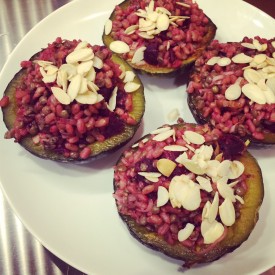
Stuffed Zucchini

  • 2 of any combination of zucchinis and yellow squash, cut the long way with the seeds scooped out
  • 1/4 cup ground flax seeds
  • 1/4 cup ground almonds
  • 1 T tamari
  • 1-2 gloves garlic, minced
  • 1/2 grated zucchini
  • 2 kale leaves, julienned
  • Handful of basil, julienned
  • Extra vigin olive oil
  • Pinch (or more) red pepper flakes

This is an easy one: Preheat oven to 350F. Mix everything. Stuff into zucchini. Cook for 15-20 minutes or until zucchini browns slightly.

Posted in CSA, Gluten Free, Recipes, vegan, Vegetarian | Tagged , , , , , , , , | 5 Comments

June Can Jam – Berry Berry Good

We live in Forest Hill, Queens. It’s pretty urban here — while not as industrial as Western Queens (like Long Island City), or as suburban as Eastern Queens (like Douglaston), we straddle the line between the city and the suburbs, and there’s nothing that resembles a farmer’s market nearby. So it has been pretty unbelievable to join up with the Forest Hills Tuv Ha’aretz CSA, and get delicious, fresh, organic vegetables 6-months out of the year straight from Golden Earthworm Organic Farm. This is our second year with the CSA, but last year, due to a couple of rain-outs, we never made it out to the farm. This year, we were determined and we made the trek out to Jamesport on an early June weekend to go Strawberry picking. How fortuitous when I found out that this month’s Can Jam ingredient was ____berries! It didn’t take long for me to fill in that blank. I mean, when does anyone in central queens have the opportunity to PICK then PRESERVE anything? Umm….never.

The farm is incredible. Located on a windy road just past Riverhead, on the North Fork of Long Island, it is picturesque. Hence the below pictures. In addition to the fields, and green houses, Golden Earthworm also keeps heritage breed sheep, pigs and goats. We actually ran into one of the farmers, Matthew, as we walked around the farm. What a privilege to have the opportunity to thank the farmer that grows one’s food!

With strawberries this good looking (and good tasting), I really didn’t want to do that much to them, so I decided to just can them in a simple syrup. The recipe was adapted (for batch size) from Ball’s Complete Book of Home Preserving.

Strawberries in Syrup

Recipe makes one 12 oz jelly jar with a few generous tablespoons left over to eat directly from the pot

  • 4 cups hulled strawberries, large ones halved
  • 3/4 cup granulated sugar

  1. In a large pot, combine strawberries and sugar and toss to coat. Cover and set aside in a cool place for 5 – 6 hours.
  2. Prepare canner, jars and lids. If you are new to canning, read THIS.
  3. Transfer pot with strawberries to stove, and heat over medium low until berries are heated through.
  4. Ladle hot strawberries into jar with 1/2 inch headspace. Wipe rim, center lid on jar, and twist screw band on.
  5. Process in boiling water bath canner for 10 minutes.

My jar boiled over during processing (I guess I didn’t have the full 1/2 inch headspace), and didn’t have time to re-process. I ended up just wiping the lid, re-closing, cooling, and putting it in the fridge. Canning experts — is it still OK? Do I need to boil again before I eat, safety-wise?

Posted in Canning, CSA, Inspiration, Recipes | Tagged , , , , | 5 Comments
  • New Here?

    This is a blog about cooking whole, seasonal food at home. Read More
  • Follow us on the Web:

    or sign up for email updates:

    We will never share your email address with anyone.